Hotels and resorts need more than a low unit price: the supplier must provide furniture that fits each zone, survives its exposure, arrives in usable condition, and remains serviceable after opening. By the end, you will be able to classify suppliers, calculate quantities, compare construction and materials, verify evidence, and turn competing quotations into a realistic delivered cost.
Key takeaways
- Calculate seating by zone, occupancy, turnover, and replacement allowance.
- Choose UV-stable, corrosion-resistant materials with replaceable components.
- Request test reports, warranties, batch details, and compliance documents.
- Compare delivery, installation, maintenance, and warranty costs—not unit prices alone.
What does an outdoor furniture wholesaler actually do?
An outdoor furniture wholesaler buys commercial quantities from one or more makers and resells them to hotels, usually combining products, logistics, and project coordination.
That differs from an outdoor furniture manufacturer, which controls fabrication and customization; a furniture distributor represents a brand or territory; a furniture dealer resells selected ranges; a sourcing agent finds suppliers for a commission; and a contract-furniture supplier manages specification, production, delivery, and installation as one project.
| Role | Price and customization | Accountability and support |
|---|---|---|
| Outdoor furniture wholesaler | Competitive volume pricing; limited-to-moderate customization | Owns the sale if named as seller; confirm warranty and spare-part duties |
| Manufacturer | Higher control over dimensions, finishes, and materials | Owns factory defects and production documentation |
| Distributor or furniture dealer | Brand-led selection; customization follows catalogue limits | Warranty route may pass through the brand |
| Sourcing agent | Adds a service fee; no inventory | Supplier remains responsible unless the contract states otherwise |
| Contract-furniture supplier | Higher coordination cost; project-specific builds | One party manages defects, delivery, installation, and claims |
Use this workflow:
- Complete the site survey and zone schedule.
- Approve a full-size sample or mock-up, including colour and cushion fabric.
- Issue a purchase order defining dimensions, wobble limits, coating defects, colour consistency, spare parts, and replacement obligations.
- Confirm production, then conduct a pre-dispatch inspection.
- Record packing, delivery, unloading, installation, and snag resolution.
- Hold replacement stock: slings, straps, glides, fasteners, cushions, covers, and tabletops.
Name the legal seller, actual manufacturer, documentation owner, defect owner, and warranty claimant in the quotation. Also require batch records for colour and weave, installation responsibility, and replacement lead time; otherwise each company can redirect your claim.
How many pieces do you need in each hotel and resort zone?
Begin with operating counts, not floor area: number of guest rooms, balconies, seats, tables, loungers, umbrellas, and bar or service points. Add the layout allowance for circulation, accessible positions, cleaning access, turnover, and peak events, then separate opening inventory from replacement stock.
- Guest rooms: count the required chairs, side tables, desks, and luggage benches per room type, then multiply by keys and add a room-set replacement reserve.
- Balconies: count usable balcony settings by room type, preserving door swing and wheelchair clearance.
- Pool decks: calculate pool deck furniture quantities from loungers per operating zone, side tables, umbrellas, weighted bases, and clear lifeguard paths.
- Restaurants and bars: count covers, tables, bar stools, host seating, and service points for peak occupancy, not average occupancy.
- Terraces, gardens, and event lawns: count planned seating clusters, cocktail tables, dining tables, umbrellas, and event reserve stock separately.
- Staff areas: count break-room seats, tables, lockers or benches, and shift-change demand.
Record these figures in a hotel furniture quantity schedule used for resort furniture planning. Include item code, finished footprint, seat height, arm height, table clearance, stacking height, packed volume, storage location, and acceptable quantity tolerance; verify all commercial furniture dimensions against the approved layout.
A chair can fit the drawing yet fail through a service door, exceed the storage cover height, or consume too much stacking space. Measure the packed chair, turning route, lift, and storage bay before ordering.
Keep replacement stock by item code, while opening inventory covers installed operation; specify separately priced glides, straps, cushions, covers, tabletops, and fasteners.
Which materials and construction details survive resort conditions?
Pool decks need chloride-tolerant, drainable construction; Delhi sites also demand resistance to ultraviolet radiation, dust, monsoon rain, humidity, sand, hard-water deposits, and urban pollution.
| Material | Weight, corrosion and heat | Maintenance, repair, cost and appearance |
|---|---|---|
| Aluminium | Light, rust-free, heats in sun; good for wind-rated designs | Low maintenance, repairable frames, mid-cost, clean modern look |
| Powder-coated steel | Heavy, strong; rust starts at chips and trapped water; heats | Low upkeep until coating fails, weld repairable, low-to-mid cost, many colours |
| Stainless steel | Heavy; 316 resists chlorides better than 304, but neither is corrosion-proof | Easy cleaning, costly, durable, precise industrial appearance |
| Teak | Heavy, stable, tolerates wetting; hot in sun | Oil or weathering care, repairable, high cost, natural appearance |
| HDPE | Medium, non-corroding, moderate heat | Easy cleaning, replaceable parts, mid-to-high cost, solid colours |
| Polypropylene | Light, non-corroding, can become brittle under UV | Low cost, limited repair, moulded appearance |
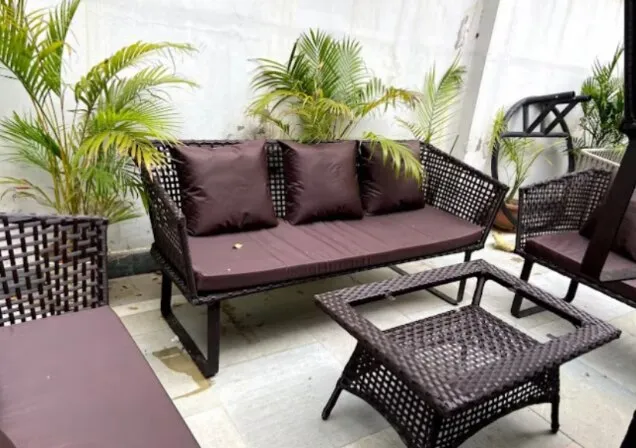
| Synthetic rattan | Light, non-corroding; UV quality varies | Easy cleaning, replaceable weave, mid-cost, woven appearance |
| Natural rattan | Light; poor resistance to rain, humidity and chlorine | Frequent care, difficult repair, indoor or covered use only |
| Mixed materials | Performance depends on every component | Check compatibility, repair paths and total cost before approval |
Specify commercial-grade outdoor furniture with load ratings, continuous commercial-grade welds, reinforced joints, and joint designs that shed water. Name fastener material, UV-stability evidence, abrasion-resistant fabric, replaceable cushions and parts, and drainage holes.
For aluminium outdoor furniture, require named pretreatment, powder coating thickness, complete edge coverage, sealed joints, tube-end protection and inspected drain holes. Add insulating washers or sleeves for galvanic isolation between dissimilar metals, especially aluminium and stainless steel. 316 stainless steel furniture still needs chloride rinsing and crevice-free detailing.
- Reject permanently wet cushions; require quick-drying cores and covers that dry after monsoon rain.
- Match wind loads and sand exposure to base weight, anchoring and abrasion-resistant glides.
- Test fabrics for lightfastness, mould resistance, water repellency and seam strength; water-repellent fabric is not waterproof.
What evidence and documents should you require before approving a batch?
Do not approve a batch from a brochure or generic “commercial grade” label. Require a traceable document pack, then test the exact sample in conditions that resemble the hotel or resort site.
1. Request product specification sheets, dimensional drawings, material declarations, care instructions, warranty terms, spare-parts lists, packing lists, tax invoices, and delivery schedules. Record item codes, materials, finishes, dimensions, load ratings, carton quantities, and replacement lead times.
2. For seating, require an EN 581-2 test report; for tables, require EN 581-3 evidence. Match the report to the quoted frame, fasteners, arms, seat material, tabletop, and configuration. A standard number without the tested configuration proves little.
3. Treat ASTM B117 salt-spray hours as comparative evidence, not a promise of outdoor service life. Also request coating thickness, pretreatment, adhesion results, and field-exposure information.
4. Inspect a physical sample or mock-up after wetting, drying, dragging, stacking, cleaning, and exposure to the actual pool or terrace. Check sharp edges, water traps, unstable feet, glare, drainage, and seat comfort.
5. For upholstery, verify fabric lightfastness, mould resistance, water-repellency, seam construction, quick-dry foam drainage, washable replaceable covers, and replaceable foam cores. Require complete-build-up ignition tests under EN 1021-1 and EN 1021-2; a water-repellent fabric alone does not make a cushion waterproof.
Write the purchase order around measurable acceptance criteria: dimensional and colour tolerances, weave variation, weld appearance, coating defects, wobble limits, inspection rights, and replacement obligations. List separately priced spare slings, straps, glides, fasteners, cushions, covers, and tabletops.
How do you compare wholesaler quotations on a like-for-like basis?
A quotation is comparable only after every line is converted to the same schedule unit: one approved chair, lounger, table, umbrella, or square metre of specified material. Use these formulas before you compare outdoor furniture quotations.
| Quoted basis | Normalised basis | Conversion |
|---|---|---|
| Pieces | Individual units | Quantity quoted ÷ 1 |
| Sets | Individual units | Sets × exact chair, table, cushion, or umbrella count |
| Square metres | Square metres installed | Area quoted, including stated wastage and edge allowance |
| Cartons | Individual units | Cartons × packed quantity, less damaged or missing pieces |
| Running metres | Running metres installed | Length quoted, matched to the specified width, finish, and wastage |
Then price the same scope. Check whether each quotation includes cushions, covers, glides, fasteners, tabletops, umbrellas, packaging, taxes, freight, unloading, assembly, installation, storage, touch-up kits, and warranty visits. List separately priced spare slings, straps, cushions, covers, tabletops, and fasteners; missing small parts can disable an otherwise sound chair.
Compare the minimum order quantity, production lead time, delivery terms, inspection rights, replacement lead time, and hotel furniture replacement stock. Require a site-specific delivery schedule and a written process for installation damage and snag resolution.
Your landed cost furniture calculation is: product price plus taxes, packaging, last-mile freight, unloading, assembly, installation, construction-period storage, site damage, and snag work, divided by usable installed units. For New Delhi, assess Bhuvi Outdoor Furniture against that identical written schedule, service obligations, inspection rights, and replacement terms—not against an ex-factory figure.
Frequently asked questions
What does an outdoor furniture wholesaler do for hotels and resorts?
A wholesaler combines products from makers, manages commercial quantities, coordinates logistics, and supports project delivery.
How many outdoor furniture pieces does a hotel or resort need?
Calculate requirements separately for pool decks, restaurants, terraces, balconies, gardens, and staff areas using capacity, occupancy, turnover, and replacement needs.
Which outdoor furniture materials survive resort conditions?
Prioritise corrosion-resistant frames, UV-stable finishes and fabrics, drainage-friendly cushions, sealed joinery, and replaceable wear parts.
What documents should you require before approving a furniture batch?
Request material specifications, test reports, warranty terms, care instructions, batch or lot details, delivery records, and relevant compliance documents.
How should you compare outdoor furniture wholesaler quotations?
Compare identical specifications, quantities, freight, installation, taxes, lead times, warranty coverage, maintenance needs, and replacement-part costs.